
Family Activities
A Rainy-Day Origami Activity: Fold, Test, and Tell a Story
Use a rainy-day origami session as a short cycle of fold, test, and story so the activity stays hands-on without requiring a large supply setup.
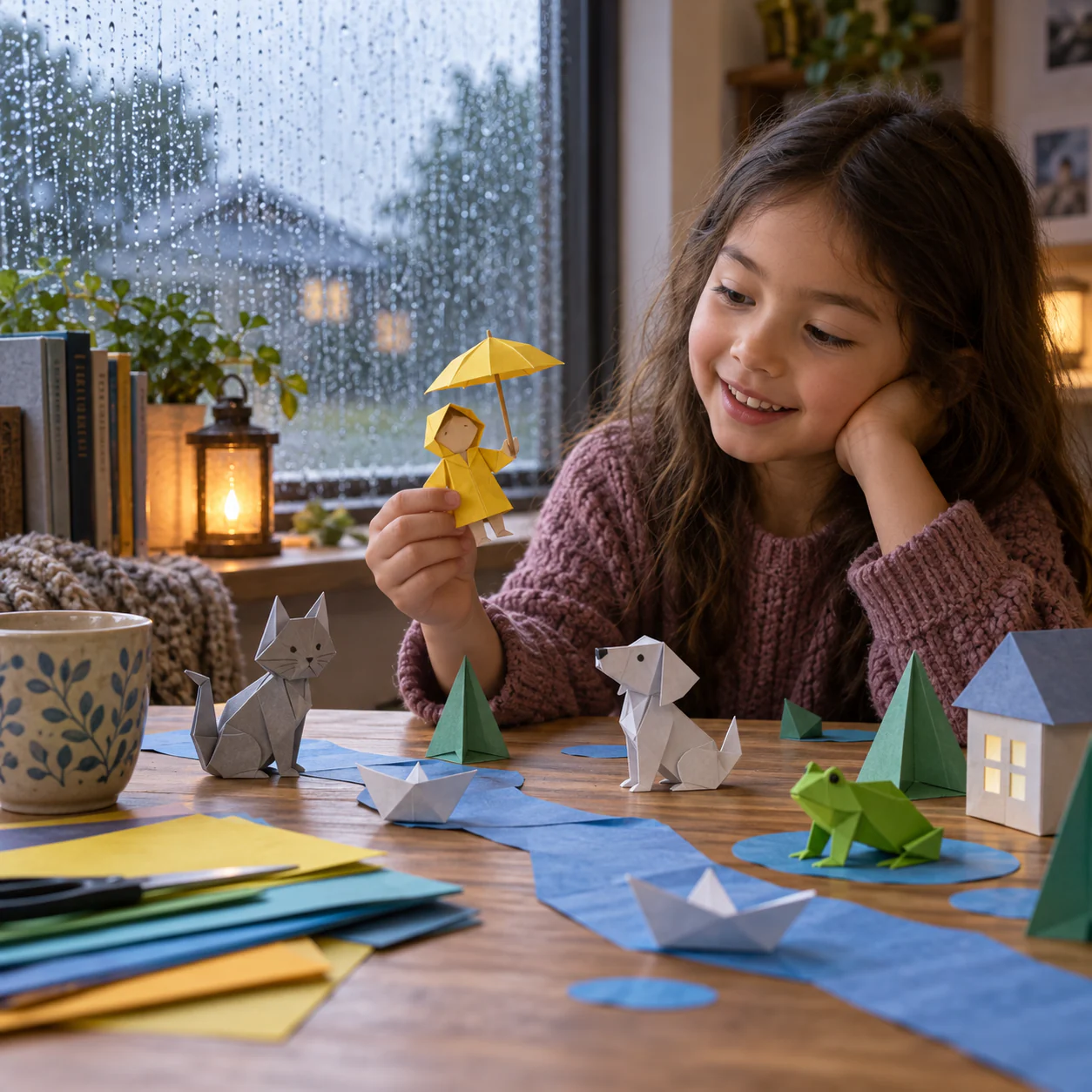
A rainy afternoon does not need a table covered in supplies. One useful format is a three-part loop: fold something, test one property, then invent a story around the result. The structure gives children and adults something to do after the final crease instead of immediately searching for another tutorial.
Pick a model with something you can test
Choose a beginner model that has a clear behavior or physical property.
A paper boat can stand and, if you choose, be tested briefly in a shallow tray. A jumping frog can hop across a dry table. A masu box can hold a few lightweight objects. A fortune teller opens and closes. A simple hat can be fitted loosely as a costume prop.
Avoid a complicated model whose only success condition is “looks exactly like the picture.” For this activity, interaction matters more than detail.
Fold once without turning the session into a correction marathon
Set out one sheet per person and one spare sheet. Read only a few steps ahead at a time.
When someone makes a small alignment error, ask whether the model can still function. If yes, keep going. If no, return only to the last reliable shape. Rainy-day crafts work better when they tolerate imperfect folds.
Use a larger sheet for younger or first-time folders so layered steps stay visible.
Give the finished model one simple test
The test should take less than five minutes.
For a box, place three lightweight items inside and see whether the walls stay upright. For a frog, mark a paper landing zone and try three gentle jumps. For a boat, see whether it stands evenly on the table before any water experiment. For a fortune teller, check whether all four finger pockets open smoothly.
The test is not a competition. It is evidence. If the model behaves differently than expected, choose one crease to inspect.
Turn the test result into a story prompt
Now ask a question the paper object can answer creatively.
A box might contain “three things a traveler packed.” A frog might be crossing “the widest river on the kitchen table.” A boat might need a name and destination. A fortune teller can become a character that only gives silly advice.
Keep the story short—three sentences, a one-minute spoken tale, or a quick drawing is enough. The point is to connect the physical model with imagination, not to create homework.
For mixed ages, let younger participants describe and older participants write if they want to collaborate.
Use a second sheet only for a deliberate retry
If someone wants to fold the same model again, ask what they want to change: straighter center alignment, larger paper, gentler creases, or a different color orientation.
That turns repetition into practice rather than duplication.
Place the first and second models beside each other. Improvement becomes visible, and an imperfect first attempt remains part of the activity instead of going straight into the trash.
Keep wet tests small and supervised
If the model is a boat and water is part of the plan, use a shallow tray on a stable surface. Ordinary paper softens when wet, so treat floating as a brief experiment, not a durability challenge.
Keep towels nearby and electronics away. Children should not be encouraged to test paper boats in tubs, ponds, sinks, or other water environments without appropriate adult supervision.
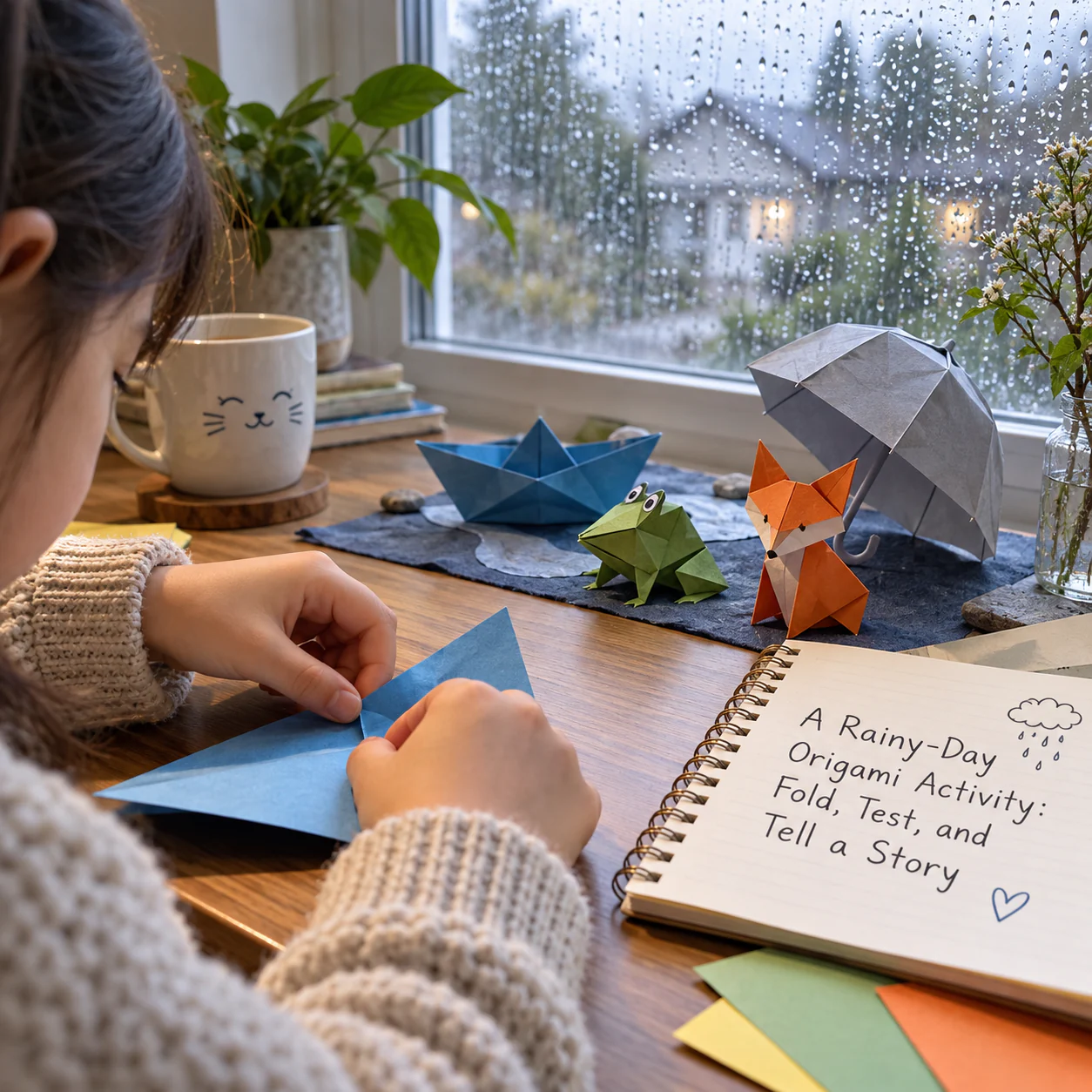
End before the table gets tired
A good rainy-day session can be one model, one test, and one story. Stop while people still associate folding with success.
Put unused paper back flat, let wet models dry separately if necessary, and save a favorite finished piece. The activity is repeatable because the next session can change just one variable: model, test, or story theme.
Keep a tiny experiment log instead of scoring winners
A half sheet of paper can turn the testing phase into observation. Write the model name, one thing you changed, and one result. For a frog, that might be “larger paper — landed straighter.” For a box, “corners met exactly — walls stood more evenly.” For a boat, “lighter paper — opened more easily.”
Do not turn the notes into a leaderboard. The purpose is to help beginners connect a physical result with a folding decision. One child may notice color and story details while another notices alignment; both observations are useful.
At the end of the session, choose one model to keep with its note. On the next rainy day, remake only that model and test the recorded change again. This gives the activity continuity without requiring a new craft purchase or an endless stream of new tutorials.