
Paper & Tools
Origami Paper for Beginners: Choose Size Before Pattern
Choose beginner origami paper by workable size and foldability first, then consider color or pattern once the model and layer count are understood.
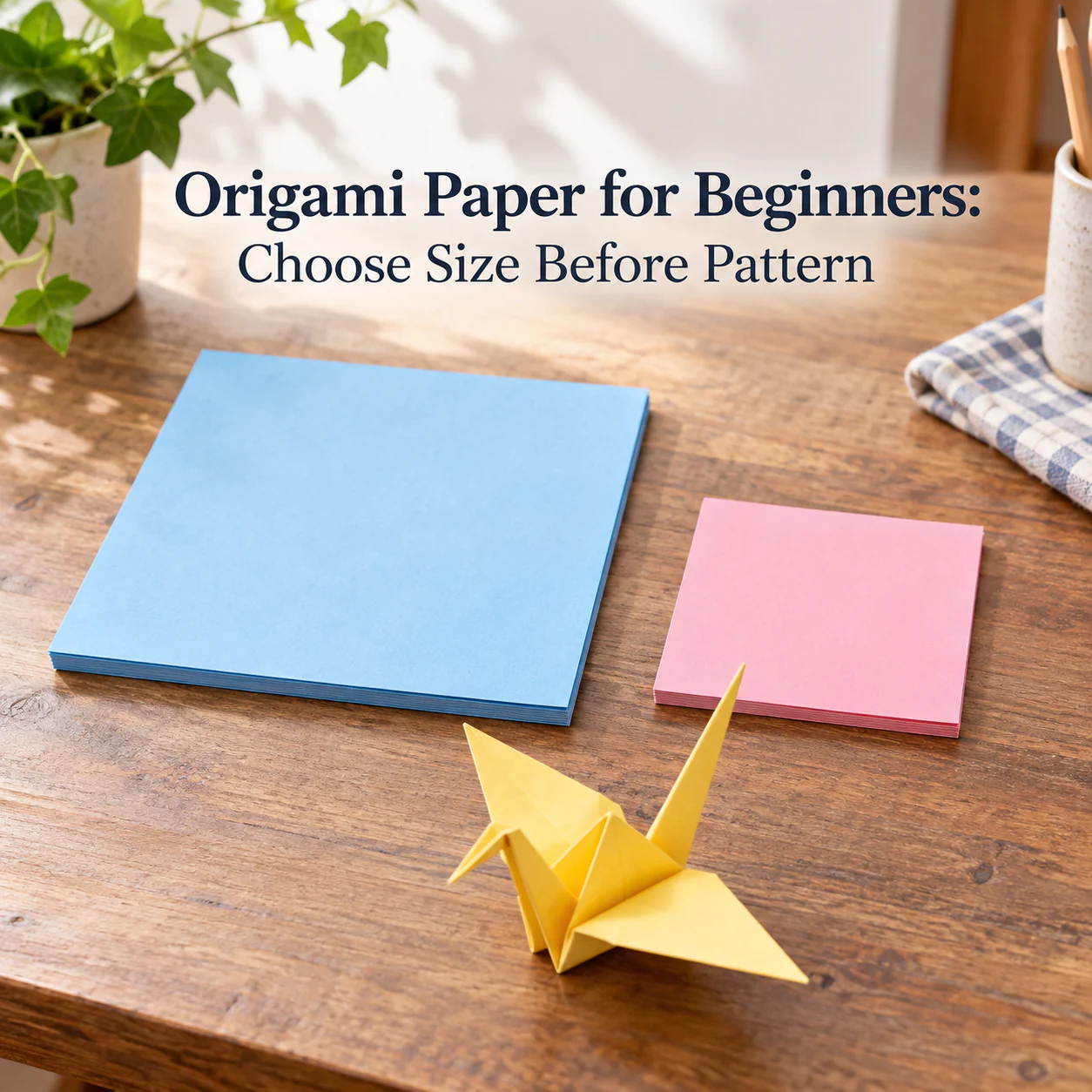
The most attractive paper in a pack is not always the easiest paper to learn with. For a beginner, size changes the physical difficulty of a model more than a floral print, metallic finish, or coordinated color palette.
Use 15 cm as a starting point, not a rule
Six-inch / 15 cm kami appears frequently in origami class supply lists because it is large enough for many simple models while still easy to rotate on a table. That makes it a reasonable default for a first box, basic animal, or crease exercise.
But model complexity changes the choice. OrigamiUSA supply lists often recommend larger sheets when a design contains more folds or needs clearer access to small flaps. A beginner may be more comfortable with 20–25 cm paper for a layered model that an experienced folder can make from 15 cm.
The right question is not “What size is standard?” It is “How small will the working area become near the end?”
Predict the final working scale
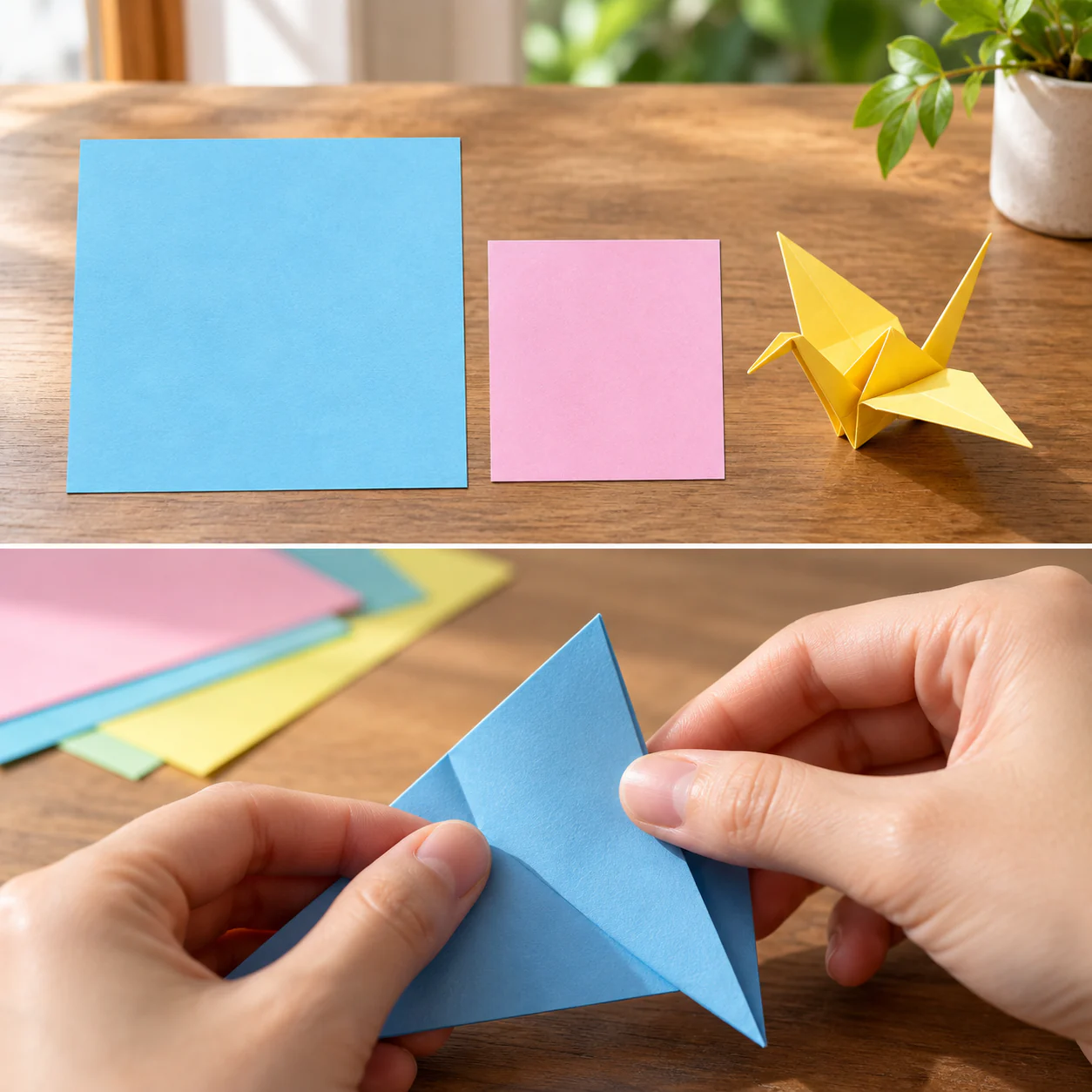
Imagine dividing the sheet in half twice. A 15 cm square quickly creates sections only a few centimeters wide. Add layered folds and your fingers may be working in an even smaller area.
If the tutorial ends with tiny ears, narrow legs, pocket folds, or several layers meeting at one point, increase the starting size.
If the model is a simple hat, boat, or broad box, a larger sheet may also make the finished object more useful. Size changes both difficulty and result.
Thin enough to fold is different from flimsy
Standard kami is popular because it creases easily and does not become excessively bulky in simple models. Copy paper is useful for practice but can feel stiffer as layers accumulate.
Thicker craft paper may produce a sturdy box while making a detailed animal unpleasant to fold. Very thin tissue-like paper may collapse or tear in a beginner's hands.
Before buying a large pack, fold one test model and notice what happens at the thickest point.
Pattern can hide the information a beginner needs
Busy prints are visually appealing, but they can disguise crease lines and layer boundaries in photo tutorials. A solid face with a contrasting reverse side is easier to read when instructions say to flip the paper or expose a color change.
For the first attempt at a new model, use a simple sheet. Once you understand which surfaces are visible, repeat it with the patterned paper you actually want to display.
This also avoids discovering at the end that the favorite motif is upside down or hidden inside the model.
Buy a mixed practice range only if the sizes serve a purpose
A small set of 15 cm squares plus a few larger sheets is more useful than twenty tiny novelty sizes with no planned model.
A practical beginner stash might include:
- 15 cm squares for everyday learning;
- 20–25 cm sheets for layered or unfamiliar models;
- inexpensive copy-paper squares for crease drills;
- a few decorative sheets saved for second attempts.
You can add tiny paper later if miniature folding becomes part of the hobby.
Let the model teach you what to buy next
After a few sessions, record which problem appeared most often. If your fingers could not access the final folds, buy larger paper. If the model became too bulky, try thinner paper. If the tutorial was hard to read, choose stronger front/back contrast.
That is a better shopping signal than a generic “best origami paper” list.
Beginner paper questions
Is bigger paper always easier? No. Larger paper gives more room for small folds, but very large sheets can be harder to align across long edges. Use enough size to make the smallest working area comfortable.
Can I learn on printer paper? Yes for many basic folds and simple models. It may feel stiffer than kami when several layers stack.
Should I buy patterned paper first? Only if the pattern motivates you and the sheet is still easy to read. For learning a new sequence, solid or two-tone paper usually makes orientation clearer.
Use a failed small model to estimate the next size
If a fold becomes impossible near the end, measure the area where your fingers ran out of room. You do not need a mathematical scaling formula; simply compare how much larger that working zone should feel. Moving from 15 cm to 20 cm gives noticeably more space throughout the sequence, while moving to 25 cm changes the handling even more.
Refold the same model at the larger size before changing paper type. If the difficulty disappears, size was the main constraint. If the folds are still bulky, thickness is a better suspect. If the layers are visible but the tutorial remains confusing, front/back contrast may be the issue.
Changing one variable at a time makes the next purchase evidence-based. It also prevents the common cycle of buying specialty paper to solve a problem that was really caused by starting too small.